
Vice-President calls for medical innovation, ethical use of technology and a stronger role for doctors in combating drug abuse
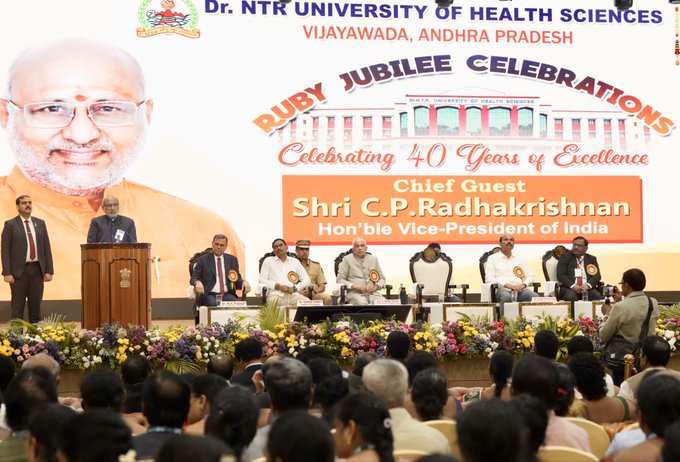
Aarogyam Times | Health News | Vijayawada | October 26, 2026: Vice-President of India C. P. Radhakrishnan has urged medical institutions to strengthen research, promote innovation and develop solutions to major healthcare challenges facing humanity. Addressing the 40th (Ruby Jubilee) anniversary celebrations of Dr. NTR University of Health Sciences in Vijayawada, Andhra Pradesh, on Monday, he emphasised that scientific progress must go hand in hand with compassion, patient safety and ethical medical practice.
Congratulating the university on completing four decades of contribution to medical education and healthcare, the Vice-President said the institution reflected the vision of former Andhra Pradesh Chief Minister Nandamuri Taraka Rama Rao, popularly known as Dr. NTR. He described Dr. NTR as a leader whose vision and commitment to public service extended beyond regional boundaries.
Medical Research Must Address Real-World Health Problems
Highlighting the importance of research and innovation, the Vice-President called on medical students, researchers and institutions to focus on pressing health challenges and develop solutions that improve people’s lives.
He expressed hope that researchers from Dr. NTR University of Health Sciences would make significant contributions to medical science and achieve international recognition for their work, including the possibility of Nobel-level achievements.
His remarks underline the growing need for medical institutions to go beyond education and clinical training by investing in scientific discovery, evidence-based treatment and innovations that address unmet healthcare needs.
AI and Digital Health Must Keep Patients at the Centre
The Vice-President highlighted the growing role of artificial intelligence (AI), digital health, telemedicine and advanced diagnostic technologies in transforming healthcare delivery.
He encouraged Dr. NTR University of Health Sciences to collaborate with leading universities and research institutions to give students and researchers greater exposure to emerging technologies and advanced scientific developments.
However, he stressed that technological advancement must be guided by scientific validation, patient safety, data privacy and ethical responsibility.
Technology, he noted, cannot replace the compassion and human connection that remain central to the doctor-patient relationship.
For patients, this is an important consideration as digital consultations, AI-assisted diagnostics and other technology-driven services become increasingly integrated into healthcare. Innovation must not only improve efficiency but also maintain clinical standards, protect sensitive medical information and preserve trust between patients and healthcare professionals.
Doctors Urged to Lead the Fight Against Drug Abuse
The Vice-President also called on doctors and healthcare professionals to take a more active role in raising awareness about drug abuse and its consequences.
Describing the fight against substance abuse as a collective responsibility, he urged the medical fraternity to lead public awareness efforts and support the goal of building a drug-free society.
Doctors can contribute to these efforts through preventive education, early identification of substance-use problems, counselling, appropriate treatment and referral to specialised support services.
As part of the anniversary programme, the Vice-President joined attendees in taking a pledge to reject drugs and promote a drug-free society.
Medical Education in India Sees Expansion
Speaking about the growth of medical education in the country, the Vice-President cited an increase in the number of medical colleges from 387 before 2014 to 846 at the time of his address.
He also highlighted an increase in MBBS seats from approximately 51,000 to more than 1.4 lakh, representing a reported rise of 172%. Postgraduate medical seats, he said, had increased from around 31,000 to more than 86,000, a reported rise of 177%.
He emphasised that the next major priority must be to translate the expansion of medical education into stronger research capabilities, greater innovation and solutions to healthcare challenges.
University Marks 40 Years of Medical Education
During the ceremony, the Vice-President released a souvenir commemorating the university’s 40-year journey.
Those present included Andhra Pradesh Governor and university Chancellor S. Abdul Nazeer; Andhra Pradesh Minister for Housing, Information and Public Relations Kolusu Parthasarathy; university Vice-Chancellor P. Chandrasekhar; and M. K. Ramesh, President of the Medical Assessment and Rating Board of the National Medical Commission, among other dignitaries.
The Vice-President was received at Vijayawada airport by the Governor, Andhra Pradesh Cabinet Minister Nara Lokesh and other officials.
The Aarogyam Times Perspective
The Vice-President’s address highlights three priorities for India’s healthcare system: stronger medical research, responsible adoption of emerging technologies and a more proactive role for healthcare professionals in preventing substance abuse.
Expanding medical education is an important step, but the long-term benefits depend on building research capacity, encouraging scientific collaboration and ensuring that innovations reach patients safely and effectively.
Ultimately, the value of medical progress lies in its ability to improve health outcomes, make quality care more accessible and ensure that compassion remains at the heart of healthcare.
Source: Press Information Bureau (PIB), Government of India, October 26, 2026.