
New Delhi: India and France have inaugurated the Indo-French Centre for AI in Health (IF-CAIH) at the All India Institute of Medical Sciences (AIIMS), New Delhi, marking a new step in international collaboration to explore how artificial intelligence (AI) can strengthen healthcare research, medical education and clinical innovation.
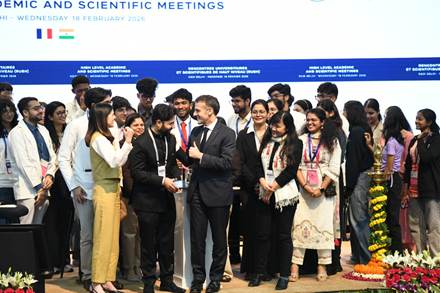
The centre was inaugurated by Union Health Minister J P Nadda and French President Emmanuel Macron during the Rencontres Universitaires et Scientifiques de Haut Niveau (RUSH) meetings held at AIIMS on February 18–19, 2026.
For patients and healthcare professionals, the initiative signals growing interest in using AI to support medical research, improve understanding of complex diseases and explore new approaches to healthcare delivery. Its potential impact will depend on the research undertaken, clinical validation and how effectively new technologies are translated into routine medical practice.
Why AI in Healthcare Matters
Artificial intelligence is increasingly being explored for tasks such as analysing medical images, identifying patterns in health data, supporting clinical decision-making and accelerating scientific research.
In areas such as brain health, AI could help researchers study complex neurological conditions, examine large datasets and investigate patterns that may be difficult to identify using conventional methods alone.
However, AI systems are tools to support healthcare professionals, not substitutes for clinical judgement. Their usefulness depends on the quality of the data used to develop them, their performance across different patient populations and appropriate testing in real-world clinical settings.
The new Indo-French centre aims to strengthen the research and academic collaboration needed to explore these possibilities.
Brain Health and Mental Health in Focus
The initiative brings together AIIMS New Delhi, Sorbonne University and the Paris Brain Institute under a joint memorandum of understanding, with academic collaboration from the Indian Institute of Technology Delhi and other leading French institutions.
One of the key themes of the RUSH meetings was the use of AI in brain health and global healthcare. Scientists, clinicians, policymakers and academic leaders discussed opportunities for collaboration and more integrated approaches to mental health challenges.
For the public, advances in this field could eventually contribute to better understanding of neurological and mental health conditions, improved research methods and the development of tools to support healthcare professionals.
Nevertheless, AI-assisted approaches must be scientifically evaluated before they can be relied upon for diagnosis or treatment. The inauguration itself does not establish that any new AI-based diagnostic service or treatment is currently available to patients through the centre.
Building Research Capacity Between India and France
The centre builds on existing cooperation between the two countries in digital health, antimicrobial resistance, health workforce development and the responsible use of health data.
Its objectives include supporting scientific discovery, evidence-based policymaking, training and academic mobility. Collaboration between medical institutions, universities and technology researchers could also help develop expertise at the intersection of medicine, computing and public health.
Such partnerships are particularly relevant as healthcare systems explore how digital technologies can be used responsibly while addressing practical challenges, including access to quality care and the need for reliable clinical evidence.
Responsible AI Must Put Patients First
During the programme, President Macron emphasised the importance of developing trusted AI capabilities and ensuring that technology serves humanity. He highlighted safeguards for children, transparency in algorithms to address bias, and respect for linguistic and cultural diversity.
These principles have direct relevance to healthcare.
AI systems trained on incomplete or unrepresentative datasets may perform differently across populations. This makes diverse patient data, independent validation and ongoing monitoring important considerations when developing healthcare applications.
Patient privacy and the responsible handling of sensitive medical information are also essential. Clear accountability is needed so that patients and healthcare professionals understand how AI tools are used and who is responsible for decisions made with their assistance.
What Could Patients Expect Next?
The establishment of IF-CAIH creates a platform for research, education and international scientific cooperation. Its longer-term value will depend on the projects it undertakes, the evidence those projects generate and whether successful innovations can be implemented safely and equitably.
For patients, the important question is not simply how advanced an AI system may be, but whether it can help improve the accuracy, accessibility, safety or quality of healthcare.
As India and France deepen their scientific partnership, the centre offers an opportunity to explore how technology can complement medical expertise while keeping patient welfare at the heart of innovation.
The Aarogyam Times Takeaway: AI could become a valuable tool in brain health research and healthcare delivery, but its promise must be matched by scientific validation, data privacy and responsible clinical use. The real measure of success will be whether these collaborations eventually translate into safer, more effective and more accessible care for people.